 TLS Online
Performance Meter
0%
QUESTION ID:1
The figure below shows mean annual temperatures (°C) and mean annual precipitation (cm per year) from multiple sites in four regions in India.

From this climatic information, we can infer that P, Q, R, and S are LIKELY to be
located in:
QUESTION ID:2
For a pair of interacting species, increased specialization and decreased niche breadth in both species would result in
QUESTION ID:3
Males of a bird species provide parental care by feeding nestlings before they fledge. Which of the following is a PROXIMATE explanation for this behaviour?
QUESTION ID:4
The courtship display of a spider species consists of both visual and vibrational signals. Females respond to the display by approaching males. In an experiment, females were presented with 3 treatments: i) only videos of displaying males, ii) only vibrational signals of the display, and iii) both videos of displaying males and vibrational signals. The results are given below:

Results from this experiment show that
QUESTION ID:5
Moth ears typically consist of a membranous eardrum backed by an air cavity. Ears in different phylogenetic groups of moths have evolved on different body parts. Moth ears are thus best described as
QUESTION ID:6
Increased anthropogenic disturbance has resulted in an overall decrease in densities of trees and an increase in fragmentation of forests. Which of the following types of trees will have the greatest reduction in reproductive success?
QUESTION ID:7
A study examined the effect of neighbours on plants when grown at low or high altitudes. The researcher measured Relative Neighbour Effect (RNE), defined as: RNE = Biomass with neighbours – Biomass without neighbours.

The results shown above demonstrate
QUESTION ID:8
Match the combination of flora and fauna from the list, to the state where they are found.
| Combination | Fauna; Flora |
| P | Red panda; Rhododendron |
| Q | Pygmy hog; Elephant grass |
| R | Tiger; Mangrove |
| S | Hangul; Chinar |
QUESTION ID:9
A parent population (P) is split into three daughter populations (Q, R, and S) which grow in three different habitats. After 1000 generations, the equilibrium frequency distribution of a trait in each of the daughter populations is shown in the figure below. For reference, the vertical line represents the mean of the parent population.

From this information, one can infer that the subpopulations experienced the
following selection regimes
QUESTION ID:10
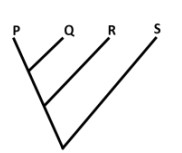
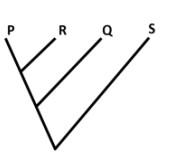
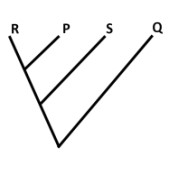
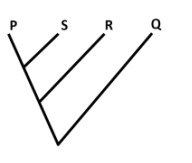
The character matrix below lists four taxa (P-S) and their nine characters (i-ix). A character state is designated as ‘0’ if it is ancestral and ‘1’ if it is derived. Which of the following phylogenetic trees is obtained by cladistic analysis of these data?

QUESTION ID:11
The reactions below (R1 and R2) represent different carbon fixation pathways in photosynthesis.
RuBP represents Ribulose bisphosphate.
Rubisco represents RuBP carboxylase-oxygenase.
PGA represents Phosphoglyceric acid.
PEP represents Phosphoenolpyruvate.

Which of the following is CORRECT?
QUESTION ID:12
A fish species is sexually dimorphic: males possess ultraviolet (UV) spots on their bodies which are lacking in females. Females prefer males with larger and more intense UV spots as mates. Which of the following statements is a plausible reason for the spots being coloured ultraviolet?
QUESTION ID:13
A climate scientist notices a trend in atmospheric CO2 concentrations (in ppm) at a research station. Although overall CO2 is rising over decades, there are intra-annual fluctuations, as shown in the figure below.

can be attributed to
QUESTION ID:14
Four islands differ in size (small = 10 km2 , large = 100 km2 ) and distance from the mainland (near = 50 km, far = 500 km). Island P is small and near the mainland; Island Q is small and far from the mainland; Island R is large and near the mainland; Island S is large and far from the mainland
Let NP, NQ, NR and NS denote the number of species on islands P, Q, R and S, respectively. Which of the following is consistent with the theory of island biogeography?
QUESTION ID:15
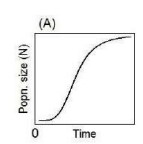
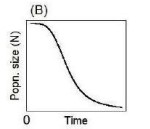
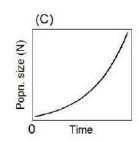
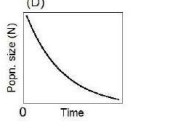
The rate of population growth (dN/dt) over time (t) is shown below. For the above population,

which of the following plots of population (Popn.) size (N) vs. time (t) is CORRECT?
QUESTION ID:16
The pedigree below details a late onset genetic disease among humans. Males are represented as squares and females as circles. Individuals with the disease are depicted as black, and those without it are depicted as white. Which of the following best describes the pattern of inheritance of the disease-causing gene?

QUESTION ID:17
Match the following scientists with the concepts or theories they are associated with.
| Scientist | Theory/Concept |
| (P) WD Hamilton | (i) Neutral Theory of Molecular Evolution |
| (Q) RA Fisher | (ii) Island Biogeography |
| (R) M Kimura | (iii) Inclusive Fitness |
| (S) RH MacArthur | (iv) Runaway Sexual Selection |
QUESTION ID:18
Which of the following is an example of complete intrinsic post-zygotic reproductive isolation between two species P and Q?
QUESTION ID:19
Match the animals to their locomotor adaptation.
| Adaptation | Animal |
| (P) Volant | (i) Ostrich |
| (Q) Fossorial | (ii) Slow Loris |
| (R) Arboreal | (iii) Naked Mole Rat |
| (S) Cursorial | (iv) Bat |
QUESTION ID:20
Paralogs are genes that are the products of gene duplication events within a species. Orthologs are genes in different species that share a common ancestral gene. The figure below describes the evolutionary history of a hypothetical gene X in organism Y. This gene undergoes a duplication event. Later, Y splits into two species Y1 and Y2, and this gives rise to four copies of the gene - P, Q, R and S. Which option best describes the relationships between the four copies of the gene X?

QUESTION ID:21
The frequency distribution of beak sizes of a bird species is symmetric but not normally distributed. If the mean value of beak size is 6 mm, standard deviation is 25 mm and kurtosis is 10, then the median is ____ mm.
QUESTION ID:22
An altruist provides help worth 10 units of fitness to a recipient, at a personal cost of 1 unit of fitness. As per kin-selection theory, the minimum value of genetic relatedness between the actors and the recipients that is necessary to maintain altruism in the population is _____ (answer up to 1 decimal place)
QUESTION ID:23
A population grows from a size of 100 individuals at t = 0, to 1000 individuals at t = 100, following density-independent growth. The ratio of per-capita growth rates at the initial (at t = 0) to the final (t = 100) time is ____.
QUESTION ID:24
The probability that a bush has a cricket is 0.1. The probability of a spider being present on a bush is 0.2. When both a spider and a cricket are present on a bush, the probability of encountering each other is 0.2. The probability of a spider consuming a cricket it encounters is 0.5. Assuming that predation only occurs on bushes, the probability that a cricket is preyed on by a spider is ____ (answer up to 3 decimal places).
QUESTION ID:25
A plant produces seeds that can be dispersed by birds or mammals. The probability that a seed is dispersed by a bird is 0.25, and by a mammal is 0.5. The bird can disperse a seed to three patches A, B, or C with a probability 0.5, 0.4 or 0.1, respectively. On the other hand, the mammal disperses a seed to the same patches A, B, or C, with a probability 0.15, 0.8 and 0.05, respectively. The probability that a given seed is dispersed to patch B is ___ (answer up to 1 decimal place).
QUESTION ID:26
The species area relationship of trees in Mudumalai Tiger Reserve is given by S = 0.1 × A0.3, where S is the number of species in a given area A. When log S is plotted against log A, the slope of the resulting relationship is _____ (answer up to 1 decimal place).