TLS Online TPP Program

#Question id: 4647


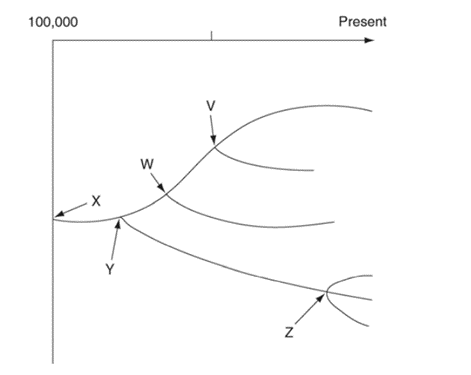
The treeʹs horizontal axis is a timeline that extends from 100,000 years ago to the present; the vertical axis represents nothing in particular. The labeled branch points on the tree (V—Z) represent various common ancestors. Letʹs say that only since 50,000 years ago has there been enough variation between the lineages depicted here to separate them into distinct species, and only the tips of the lineages on this tree represent distinct species. Which of the five common ancestors, labeled V—Z, has been most successful in terms of the percent of its derived species that are extant?

#Unit 11. Evolution and Behavior
  1. Z

  2. W

  3. X

  4. Y

More Questions
TLS Online TPP Program

#Question id: 5012

#Unit 11. Evolution and Behavior

A

Silurian

I

Seed plants appear

B

Devonian

II

Gymnosperms dominant

C

Carboniferous

III

Invasion of land by primitive land plants

D

Jurassic

IV

first reptiles

TLS Online TPP Program

#Question id: 5013

#Unit 11. Evolution and Behavior

Following is correct match

PeriodsAge of evolutionary event
A- JurassicI- Fish
B- OrdovicianII- Amphibian
C- DevonianIII- Gymnosperm
D-Carbonyferous
IV- Invertebrates

TLS Online TPP Program

#Question id: 5014

#Unit 11. Evolution and Behavior

 Following geological time period and major evolutionary event?

I. Devonian                            A. Gymnosperms dominant

II. Jurassic                               B. Amphibians diversify; first reptiles

III. Carboniferous                  C. Mammals appear

IV. Triassic                           D. Seed plants appear

TLS Online TPP Program

#Question id: 5015

#Unit 11. Evolution and Behavior

 During which of the following largest mass extinction recorded in the history of life on Earth.

TLS Online TPP Program

#Question id: 5016

#Unit 11. Evolution and Behavior

Approximately how far back in time does the fossil record extend?

TLS Online TPP Program

#Question id: 5017

#Unit 11. Evolution and Behavior

Arrange these events from earliest to most recent.

1.  emission of lava in what is now Siberia at time of Permian extinctions

2.  emission of lava that solidified at the same time as iron-bearing terrestrial rocks began to rust

3.  emission of lava that solidified at the same time as rusted iron precipitated from seawater

4.  emission of lava in what is now India at time of Cretaceous extinctions