
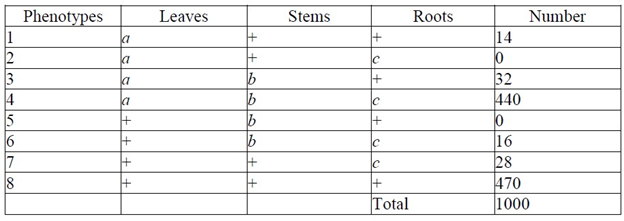
#Question id: 5360
#Unit 8. Inheritance Biology
Following some different genetic disorder traces in families.
|
Family |
Father |
Mother |
Son |
Daughter |
|
A |
Affected |
Affected |
Unaffected |
Unaffected |
|
B |
Affected |
Affected |
Unaffected |
Affected |
|
C |
Unaffected |
Unaffected |
Undetermined |
Affected |
|
D |
Affected |
Unaffected |
Unaffected |
Affected |
Which of the following possible mode of inheritance in the Family A, B, C and D respectively
#Question id: 4799
#Unit 8. Inheritance Biology
You set up a mapping cross involving your favorite gene (YFG) in Neurospora and determine the following octad types: 4:4 arrangement 83; 2:4:2 arrangement 7; 2:2:2:2 arrangement 10. What is the distance between your gene and the centromere?
#Question id: 4800
#Unit 8. Inheritance Biology
You set up a mapping cross involving two genes of interest in Saccharomyces and determine the following tetrad types: 8 nonparentalditype; 12 tetratype; 80 parental ditype. Calculate the most accurate map distance between these two genes.
#Question id: 4801
#Unit 8. Inheritance Biology
You set up a mapping cross involving two genes in Aspergillus and determine the following percentages of tetrad types: parental ditype 51%, nonparentalditype 49%. What can you say about your genes?
#Question id: 4802
#Unit 8. Inheritance Biology
Why is tetrad analysis useful for studying genetics?
#Question id: 4803
#Unit 8. Inheritance Biology
Linked genes: