TLS Online TPP Program

#Question id: 7184


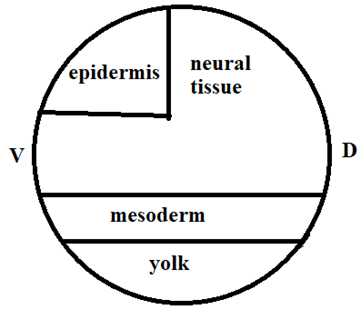
The figure above represents a late zebrafish gastrula. The following concepts may be proposed during further development of the embryo.

A. The concentration of FGF decreases from the yolk towards the epidermis, along with the increase of BMP activity from the dorsal to the ventral axis.

B. Increase in FGF activity in the epidermis with concomitant decrease in BMP activity towards the ventral axis.

C. Neural induction in zebrafish is independent of the organizer and depends on activation of BMP signalling.

D. In comparison, both Xenopus and chick embryos require activation of FGF for neural induction to occur in addition to BMP inhibition.

Which of the above statements are incorrect?

#Unit 5. Developmental Biology
  1. A and C
  2. B and C
  3. A and D
  4. C and D
More Questions
TLS Online TPP Program

#Question id: 4536

#Unit 3. Fundamental Processes

The human b-interferon gene is activated in cells upon viral infection through some activators, EXCEPT one

TLS Online TPP Program

#Question id: 4537

#Unit 3. Fundamental Processes

The enhancer DNA is __, but once the activators are bound it is relatively  , HMGA1 the DNA and thus helps the final structure form.

TLS Online TPP Program

#Question id: 4538

#Unit 3. Fundamental Processes

We first consider a generic case. Gene A is controlled by four signals (1, 2, 3, and 4), each working through a separate activator (activators 1, 2, 3, and 4). Gene B is controlled by three signals (3, 5, and 6), working through activators 3, 5, and 6. It shows-

TLS Online TPP Program

#Question id: 4539

#Unit 3. Fundamental Processes

The yeast S. cerevisiae exists in three forms: two haploid cells of different mating types—a and alpha and the diploid formed when an a and an a cell mate and fuse. The a cell and the a cell each encodes cell-type-specific regulators: a cells make the regulatory protein a1, and alpha cells make the proteins alpha1 and alpha2. A fourth regulatory protein, called Mcm1, is also involved in regulating the mating-type-specific genes (and many other genes) and is present in both cell types which shows Combinatorial Control.

The arrangement of regulators at the promoters of a-specific genes and a-specific genes is

cell type:

gene regulatory proteins:

target genes:

1.a cell (haploid)

a1

Mcm1

aSG

alphaSG

2.αlpha cell (haploid)

alpha 1

alpha 2

Mcm2

hSG

3.a/αlpha cell (diploid)

a1

Mcm2

alpha2

TLS Online TPP Program

#Question id: 4540

#Unit 3. Fundamental Processes

Transcription of eukaryotic genes can be repressed in various ways. These include the four mechanisms

1. Competition

a-Repression is caused by recruiting histone modifiers that alter nucleosomes in ways that inhibit transcript

2. Inhibition

b-A repressor binds to a site on DNA beside an activator and interacts with that activator, occluding its activating region

3. Direct repression

c-By binding to a site on DNA that overlaps the binding site of an activator, a repressor can inhibit binding of the activator to a gene and thus block activation of that gene.

4. Indirect repression

d-A repressor binds to a site upstream of a gene and, by interacting with the transcriptional machinery at the promoter in some specific way, inhibits transcription initiation.


TLS Online TPP Program

#Question id: 4541

#Unit 3. Fundamental Processes

Mig1 recruits a “repressing complex” containing the Tup1 protein. This complex is recruited by many yeast DNA-binding proteins that repress transcription, including the alpha2 protein involved in controlling the mating-type specific. Tup1 also has counterparts in mammalian cells, choose correct mechanisms have been proposed to explain the repressing effect of Tup1.

I-Tup1 acts on nucleosomes either through recruiting histone deacetylases and/or by positioning a nucleosome at or near the transcription start site.

II-Tup1 interacts directly with the transcriptional machinery at the promoter and inhibits initiation.