TLS Online TPP Program

#Question id: 710


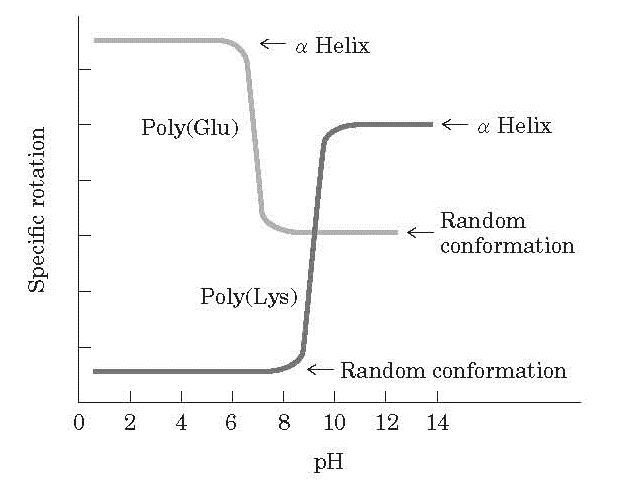
Which is the correct explanation for the effect of the pH changes on the conformations of poly(Glu) and poly(Lys)

#Unit 1. Molecules and their Interaction Relevant to Biology
  1. repulsion maximised at pH 1 and pH 12 for Lys and Glu

  2. repulsion maximised at pH 1 and pH 12 for Glu and Lys

  3. No repulsion at pH 1 and pH 12 for Lys and Glu

  4. repulsion minimised at pH 1 and pH 12 for Lys and Glu

More Questions
TLS Online TPP Program

#Question id: 633

#Unit 1. Molecules and their Interaction Relevant to Biology

An amino acid transporter protein is responsible for the transport of a specific amino acid across a membrane. The KI values of several competitive inhibitors of the amino acid transporter are shown above. Based on these data, which of the following is most likely the amino acid transported by this protein?

TLS Online TPP Program

#Question id: 634

#Unit 1. Molecules and their Interaction Relevant to Biology

An enzyme has a Vmax of 50 micromol product formed (minute x mg protein)-1 and a Km of 10 microM for the substrate. When a reaction mixture contains the enzyme and 5 microM substrate, which of the following percentages of the maximum velocity will be closest to the initial reaction rate?

TLS Online TPP Program

#Question id: 635

#Unit 1. Molecules and their Interaction Relevant to Biology

The enymatic rate constant (kcat/Km) of orotidine 5ʹ-phosphate decarboxylase is 6 x 10⁷ M-1s-1 and the nonenzymatic rate constant (kn) is 3 x 10-16 s-1.  What is the value of the enzymeʹs catalytic proficiency?

TLS Online TPP Program

#Question id: 636

#Unit 1. Molecules and their Interaction Relevant to Biology

DNA polymerase contains a lysine residue that is important for binding to DNA. Mutations were found that converted this lysine to either glutamate, glycine, valine, or arginine. Which mutations would be predicted to be the most and least harmful to the ability of the enzyme to bind DNA?

Most

Least

(A)

Valine

Aspartate

(B)

Glycine

Arginine

(C)

Arginine

Glycine

(D)

Glutamate

Arginine

TLS Online TPP Program

#Question id: 637

#Unit 1. Molecules and their Interaction Relevant to Biology

Effect of temperature on enzymatic catalysis is analysed by the rate v of a chemical reaction varies with temperature according to the Arrhenius Equation which explains the sensitivity of enzyme reactions to temperature. A plot to determination of the activation energy Ea involves

TLS Online TPP Program

#Question id: 638

#Unit 1. Molecules and their Interaction Relevant to Biology

Match the following class of enzymes with them

EnzymeClass of enzyme
A. Hexokinase1
B. Phosphoglucoisomerase2
C. Glyceraldehyde 3-phosphate dehydrogenase3
D. Phosphoglycerate mutase4
E. Enolase5
F. Aldolase