TLS Online TPP Program

#Question id: 2006


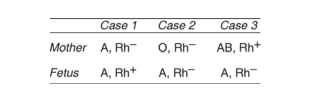
In Cases 1 and 2 in the table, the mothers would be able, if needed, to supply blood to the newborn even 7-9 months after birth; the same would not be true for Case 3. Why?

#Section 2: General Biology
  1. The fetus in Case 3 would provoke an immune response in the mother that would carry over after the birth.

  2. The newborn in Case 3 would soon be able to make antibodies to the B antigen of the mother.

  3. Newborn children, until about age 2, do not make appreciable antibodies, except against Rh+ antigen. 

  4. Passive immunity would have worn off for the third newborn, but not for the other two.

More Questions
TLS Online TPP Program
#Question id: 390

#Section 4: Fundamentals of Biological Engineering

What are the properties arising due to varying concentrations of solute in a given solvent, irrespective of the nature of solute with respect to the solvent?

TLS Online TPP Program

#Question id: 391

#Section 4: Fundamentals of Biological Engineering

In a hospital laboratory, a 10.0 mL sample of gastric juice, obtained several hours after a meal, was titrated with 0.1 M NaOH to neutrality; 7.2 mL of NaOH was required. The patient’s stomach contained no ingested food or drink, thus assume that no buffers were present. What was the pH of the gastric juice?

TLS Online TPP Program

#Question id: 392

#Section 4: Fundamentals of Biological Engineering

When an ionic compound such as sodium chloride (NaCl) is placed in water, the component atoms of the NaCl crystal dissociate into individual sodium ions (Na+) and chloride ions (Cl-). In contrast, the atoms of covalently bonded molecules (e.g., glucose, sucrose, glycerol) do not generally dissociate when placed in aqueous solution. Which of the following solutions would be expected to contain the greatest number of solute particles (molecules or ions)?

TLS Online TPP Program

#Question id: 393

#Section 4: Fundamentals of Biological Engineering

Carbon dioxide (CO2) is readily soluble in water, according to the equation CO2 + H2O ↔ H2CO3. Carbonic acid (H2CO3) is a weak acid. If CO2 is bubbled into a beaker containing pure, freshly distilled water, which of the following graphs correctly describes the results?

TLS Online TPP Program

#Question id: 394

#Section 4: Fundamentals of Biological Engineering

What will be the H+ ion concentration in a solution prepared by mixing 50.0 mL of 0.20 M NaCl, 25 mL of 0.10M NaOH and 25.0 mL of 0.30M HCl?

TLS Online TPP Program

#Question id: 395

#Section 4: Fundamentals of Biological Engineering

How would acidification of seawater affect marine organisms? Acidification of seawater would ________.