TLS Online TPP Program

#Question id: 4643


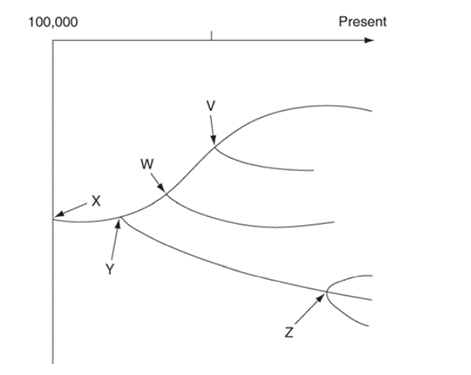
The treeʹs horizontal axis is a timeline that extends from 100,000 years ago to the present; the vertical axis represents nothing in particular. The labeled branch points on the tree (V—Z) represent various common ancestors. Letʹs say that only since 50,000 years ago has there been enough variation between the lineages depicted here to separate them into distinct species, and only the tips of the lineages on this tree represent distinct species.

How many separate species, both extant and extinct, are depicted in this tree?

#Section 2: Evolution
  1. 2

  2. 3

  3. 6

  4. 5

More Questions
TLS Online TPP Program
#Question id: 3264

#Section 2: Evolution

Which of the following is (are) true of natural selection?

TLS Online TPP Program

#Question id: 3265

#Section 2: Evolution

If the curve shifts to the left or to the right, there is no gene flow, and the population size consequently increases over successive generations, then which of these is (are) probably occurring?

TLS Online TPP Program

#Question id: 3524

#Section 2: Evolution

Which of the following genotypes would produce the greatest variety of gametes of the alleles assorted independently?

TLS Online TPP Program

#Question id: 3266

#Section 2: Evolution

One species mates at the season when daylight is increasing from 13 hours to 13 hours, 15 minutes; another species mates at the season when daylight is increasing from 14 hours to 14 hours, 15 minutes. The isolating mechanism is

TLS Online TPP Program

#Question id: 3267

#Section 2: Evolution

In a typical Mendelian population, individuals carrying gene ‘a’ in homozygous condition suffer from phenylketonurea. Those with A in homozygous condition are normal. Others, who are heterozygotic with Aa, are carriers. If the frequency of ‘a’ in a population is 0.20, what is the percentage of normal individual in the population?

TLS Online TPP Program

#Question id: 3268

#Section 2: Evolution

A population of insects is in Hardy-Weinberg equilibrium for a gene with alleles A = orange and a = yellow eyes. There are 91% orange and 9% yellow individuals in the population. If the fitness of the yellow phenotype suddenly drops to zero, what will be the allele frequency in the next generation?