TLS Online TPP Program

#Question id: 4709


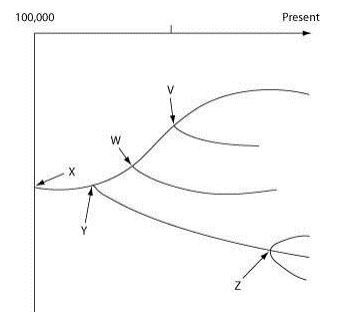
 The horizontal axis of the cladogram depicted below is a timeline that extends from 100,000 years ago to the present; the vertical axis represents nothing in particular. The labeled branch points on the tree (V-Z) represent various common ancestors. Let's say that only since 50,000 years ago has there been enough variation between the lineages depicted here to separate them into distinct species, and only the tips of the lineages on this tree represent distinct species.

 In Darwin's tree of life, each fork in the tree represents ________.

#Section 2: Evolution
  1. groups of living organisms

  2. groups of extinct organisms

  3. the most recent common ancestor of the subsequent branches

  4. morphologic gaps in the fossil record

More Questions
TLS Online TPP Program
#Question id: 10752

#Section 2: Evolution

Which of the following is an example of Batesian mimicry?

A) a butterfly that resembles a leaf

B) a nonvenomous larva of a moth that moves like a venomous snake

C) a fawn with fur coloring that camouflages it in the forest environment

D) a snapping turtle that uses its tongue to mimic a worm, thus attracting fish

TLS Online TPP Program

#Question id: 10753

#Section 2: Evolution

Which of the following is correct combination? 


TLS Online TPP Program

#Question id: 10754

#Section 2: Evolution

Following is different type of interaction was shown in figure. (+: Benefit , - Harm , 0= Neither benefit nor harm) What is interaction between column A & B in each schematic?


TLS Online TPP Program

#Question id: 10755

#Section 2: Evolution

For two species A and B in competition, the carrying capacities, competition coefficients, per capita growth rate and population size are

KA = 1000          KB = 1200        α= .5    r A= .3    N1= 500         N2= 200          

According to the Lotka-Volterra model, what is growth rate of species A?

TLS Online TPP Program

#Question id: 10814

#Section 2: Evolution

A Population of N1 species is growing with N2 species with a growth rate (r1) of 0.15 in an environment with a carrying capacity K1 of 400, Density of N1 species 100, density of N2 species 50 competitive efficiency of N2 on N1 species 1.5. What is the approximate growth rate N1 species?

TLS Online TPP Program

#Question id: 10815

#Section 2: Evolution

The evolution of two interacting species in a community is referred to as ________________.