TLS Online TPP Program

#Question id: 4103


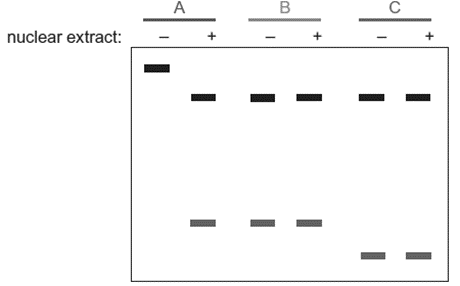
In a biochemical experiment, you compare the products from splicing reactions carried out in vitro using three different substrates. In each case the substrate is a construct containing a single intron surrounded by two exons, and in all cases the construct is the same overall size. But in one case, the intron is a group I intron, in another a group II intron, and in the third an intron removed by the spliceosome. Each construct is labelled in a manner that allows it to be detected after gel electrophoresis, and each is tested in two reactions—one, conditions that support self-splicing, and two, in the presence of nuclear extract as well. Note that, for simplification, only the final products of the splicing reaction are seen, but before degradation of the introns.

 Which of the following observation is/are correct?

A. In lane A, the presence of nuclear abstract, a band for the lariat and the spliced product and pre-mRNA.

B. Lane B shows Group I Introns and Lane C is for Group II introns and reaction is nonself-splicing

C. Lane C is Group I intron. Splicing takes place in the absence and presence of nuclear abstract, and the reaction is self-splicing.

#XL - Q Biochemistry
  1. A only

  2. B & C only   

  3. A, B & C   

  4. A & C only

More Questions
TLS Online TPP Program

#Question id: 10331

#XL - S Microbiology

When using a cladistic approach to systematics, which of the following is considered most important for classification?

TLS Online TPP Program

#Question id: 10332

#XL - S Microbiology

The four-chambered hearts of birds and the four-chambered hearts of mammals evolved independently of each other. If one were unaware of this independence, then one might logically conclude that

TLS Online TPP Program

#Question id: 10334

#XL - Q Biochemistry

N2 combines with hydrogen to form ammonia under elevated temperature (about 200°C) and high pressure (about 200 atmospheres) and in the presence of a metal catalyst (usually iron). The extreme conditions are required to overcome the high activation energy of the reaction. This nitrogen fixation reaction, called

TLS Online TPP Program

#Question id: 10335

#XL - Q Biochemistry

plants can store high levels of nitrate, and they can translocate it from tissue to tissue without deleterious effect. Yet if livestock or humans consume plant material that is high in nitrate, they may suffer with,

TLS Online TPP Program

#Question id: 10336

#XL - Q Biochemistry

methemoglobinemia, a disease, What will cause inside the human body?

TLS Online TPP Program

#Question id: 10337

#XL - Q Biochemistry

In biological nitrogen fixation, the process of nitrification by organism respective bacteria A--which convert the ammonia to nitrite and B--- further converted into nitrate in the soil by their respective A and B bacteria known as;