TLS Online TPP Program

#Question id: 801


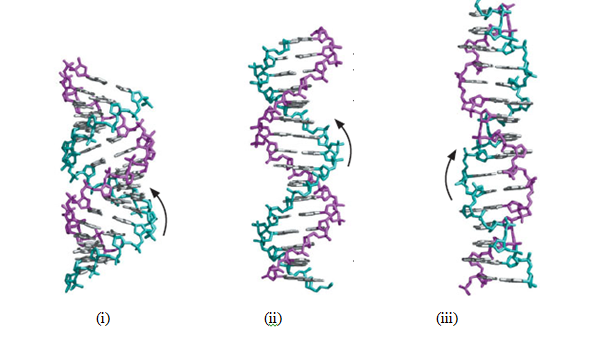
Identify the type of DNA from the structures given below and match the correct form with its characteristics described.

#Unit 1. Molecules and their Interaction Relevant to Biology
  1. (ii) – The more compact A form of DNA has 11 bp per turn and shows a large tilt of the base pairs with respect to the helix axis.

  2. (i) – The B form, which is observed at high humidity, most closely corresponds to the average structure of DNA under physiological conditions.

  3. (iii) – Z DNA is a left-handed helix and has a zigzag (hence “Z”) appearance and has an anti-conformation of glycosyl bond.

  4. (i) – The A form which is observed under low humidity has a structure similar to the structure that RNA adopts when double-helical.

More Questions
TLS Online TPP Program

#Question id: 10365

#Unit 6. System Physiology – Plant

Why the nitrogenase enzymes catalyzes the nitrogen fixation reaction only in microanaerobic or anaerobic conditions?

TLS Online TPP Program

#Question id: 10364

#Unit 6. System Physiology – Plant

Which of the following is the most common type of symbiosis occurs between members of the plant family and soil bacteria?

TLS Online TPP Program

#Question id: 10363

#Unit 6. System Physiology – Plant

Free living nitrogen fixing takes place as shown in the following;

             TYPE                                                                                       N-FIXING GENERA

A) Cyanobacteria (blue-green algae)                                        i) Bacillus

B) Aerobic                                                                                     ii) Clostridium

C) Facultative                                                                              iii) Anabaena

D) Anaerobic nonphotosynthetic                                            iv) Rhodospirillum

E) Anaerobic photosynthetic                                                     v) Azospirillum

 Which of the following combination of free living nitrogen fixing bacteria is correct?

TLS Online TPP Program

#Question id: 10361

#Unit 6. System Physiology – Plant

The carbon skeleton for amino acids derives from 3-phosphoglycerate generated during glycolysis is called anaplueratic reaction. Generated amino acids from 3-PGA is that,

TLS Online TPP Program

#Question id: 10360

#Unit 6. System Physiology – Plant

How much ATP require in the nitrogen fixation or conversion of ammonium assimilation in the system?

TLS Online TPP Program

#Question id: 10357

#Unit 6. System Physiology – Plant

Why the glutamine and glutamate will not be transported while  asparagine will prefer to be transported?