TLS Online TPP Program

#Question id: 5680


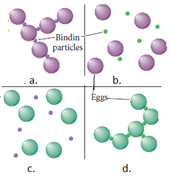
In vitro model of species-specific binding shows in figure. Add the bindin particles to a plastic well containing a suspension of eggs. After 2–5 minutes of gentle shaking, the wells were photographed.

 According to this figure, which of the following conclusion correctly define the phenomenon of species specificity?

#Unit 5. Developmental Biology
  1. Figure a and d shows bindin bound to and agglutinated eggs from its own and closely related species.

  2. Figure a and c shows no agglutination means bindin particles do not interact with eggs fom different species.

  3. Figure b and c shows no agglutination means in vitro bindin particles do not perform species specific binding.

  4. Figure a and d shows Each bindin bound to and agglutinated only eggs from its own species.

More Questions
TLS Online TPP Program
#Question id: 5203

#Unit 11. Evolution and Behavior

The biggest problem with the shotgun technique is its tendency to underestimate the size of the genome. Which of the following might best account for this?

TLS Online TPP Program

#Question id: 5199

#Unit 11. Evolution and Behavior

For mapping studies of genomes, most of which were far along before 2000, the 3 -stage method was often used. Which is the usual order in which the stages were performed, assuming some overlap of the three?

TLS Online TPP Program

#Question id: 5012

#Unit 11. Evolution and Behavior

A

Silurian

I

Seed plants appear

B

Devonian

II

Gymnosperms dominant

C

Carboniferous

III

Invasion of land by primitive land plants

D

Jurassic

IV

first reptiles

TLS Online TPP Program

#Question id: 5014

#Unit 11. Evolution and Behavior

 Following geological time period and major evolutionary event?

I. Devonian                            A. Gymnosperms dominant

II. Jurassic                               B. Amphibians diversify; first reptiles

III. Carboniferous                  C. Mammals appear

IV. Triassic                           D. Seed plants appear

TLS Online TPP Program

#Question id: 5015

#Unit 11. Evolution and Behavior

 During which of the following largest mass extinction recorded in the history of life on Earth.

TLS Online TPP Program

#Question id: 5017

#Unit 11. Evolution and Behavior

Arrange these events from earliest to most recent.

1.  emission of lava in what is now Siberia at time of Permian extinctions

2.  emission of lava that solidified at the same time as iron-bearing terrestrial rocks began to rust

3.  emission of lava that solidified at the same time as rusted iron precipitated from seawater

4.  emission of lava in what is now India at time of Cretaceous extinctions