TLS Online TPP Program

#Question id: 3632


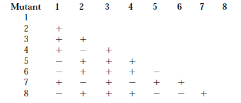
geneticist is working with a new bacteriophage called phage Y3 that infects E. coli. He has isolated eight mutant phages that fail to produce plaques when grown on E. coli strain K. To determine whether these mutations occur at the same functional gene, he simultaneously infects E. coli K cells with paired combinations of the mutants and looks to see whether plaques are formed. He obtains the following results. (A plussign means that plaques were formed on E. coli K; a minussign means that no plaques were formed on E. coli K.)

How many cistron belong to these mutation?

#Unit 8. Inheritance Biology
  1. 2

  2. 6

  3. 4

  4. 3

More Questions
TLS Online TPP Program

#Question id: 10333

#Unit 6. System Physiology – Plant

Four elements, oxygen, carbon, and hydrogen and nitrogen are the major components of most organic compounds, which of the following elements are more abundant in plants ?

TLS Online TPP Program

#Question id: 10335

#Unit 6. System Physiology – Plant

plants can store high levels of nitrate, and they can translocate it from tissue to tissue without deleterious effect. Yet if livestock or humans consume plant material that is high in nitrate, they may suffer with,

TLS Online TPP Program

#Question id: 10334

#Unit 6. System Physiology – Plant

N2 combines with hydrogen to form ammonia under elevated temperature (about 200°C) and high pressure (about 200 atmospheres) and in the presence of a metal catalyst (usually iron). The extreme conditions are required to overcome the high activation energy of the reaction. This nitrogen fixation reaction, called

TLS Online TPP Program

#Question id: 10336

#Unit 6. System Physiology – Plant

methemoglobinemia, a disease, What will cause inside the human body?

TLS Online TPP Program

#Question id: 10337

#Unit 6. System Physiology – Plant

In biological nitrogen fixation, the process of nitrification by organism respective bacteria A--which convert the ammonia to nitrite and B--- further converted into nitrate in the soil by their respective A and B bacteria known as;

TLS Online TPP Program

#Question id: 10338

#Unit 6. System Physiology – Plant

Nitrate from the soil solution actively absorb by Plant roots via several low- and high-affinity transporters known as