TLS Online TPP Program

#Question id: 3401


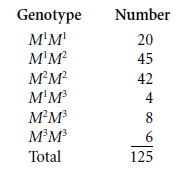
Genotypes of leopard frogs from a population in central Kansas were determined for a locus that encodes the enzyme malate dehydrogenase. The following numbers of genotypes were observed: What would be the expected numbers of genotypes if the population were in Hardy-Weinberg equilibrium?

#Unit 11. Evolution and Behavior
  1. M1M1 (16), M1M2 (40), M2M2 (50), M1M3(07), M2M3(12), M3M3(3)

  2. M1M1 (18), M1M2 (48), M2M2 (32), M1M3(08), M2M3(13), M3M3(1)

  3. M1M1 (20), M1M2 (45), M2M2 (42), M1M3(04), M2M3(8), M3M3(6)

  4. M1M1 (16), M1M2 (48), M2M2 (37), M1M3(08), M2M3(13), M3M3(2)

More Questions
TLS Online TPP Program

#Question id: 1533

#Unit 4. Cell Communication and Cell Signaling

Why might using retroviral vectors for gene therapy increase the patient's risk of developing cancer?

TLS Online TPP Program

#Question id: 1532

#Unit 4. Cell Communication and Cell Signaling

For a particular microarray assay (DNA chip), cDNA has been made from the mRNAs of a dozen patients' breast tumor biopsies. Which of the following types of evidence will researchers be looking for in order to determine if the cells are cancerous?

TLS Online TPP Program

#Question id: 1530

#Unit 4. Cell Communication and Cell Signaling

What are the differences and similarities between the transforming genes of retroviruses and those of DNA tumor viruses?

TLS Online TPP Program

#Question id: 1529

#Unit 4. Cell Communication and Cell Signaling

Which of the following statements are true regarding to gain-of-function and loss-of-function mutations with respect to cancer.

TLS Online TPP Program

#Question id: 1528

#Unit 4. Cell Communication and Cell Signaling

Mutation of p53 is described as a dominant-negative mutation. Which of the following statement is correct regarding to the mechanism by which this mutation causes the dominant-negative phenotype?

TLS Online TPP Program

#Question id: 1527

#Unit 4. Cell Communication and Cell Signaling

Following are the six fundamental properties of malignant tumors. Which of these properties are amenable to study in a cell culture model of cancer?

(I) self-sufficiency in growth signals

(II) insensitivity to antigrowth signals

(III) evasion of apoptosis

(IV) limitless replicative potential

(V) sustained angiogenesis

(VI) tissue invasion and metastasis