TLS Online TPP Program

#Question id: 4647


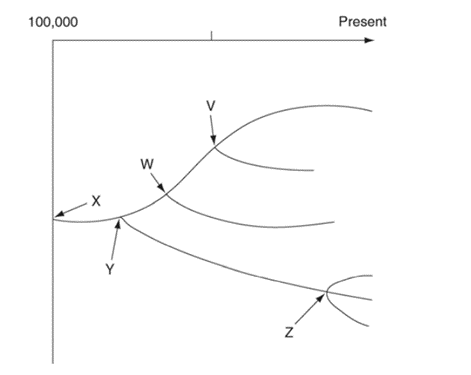
The treeʹs horizontal axis is a timeline that extends from 100,000 years ago to the present; the vertical axis represents nothing in particular. The labeled branch points on the tree (V—Z) represent various common ancestors. Letʹs say that only since 50,000 years ago has there been enough variation between the lineages depicted here to separate them into distinct species, and only the tips of the lineages on this tree represent distinct species. Which of the five common ancestors, labeled V—Z, has been most successful in terms of the percent of its derived species that are extant?

#Section 2: Evolution
  1. Z

  2. W

  3. X

  4. Y

More Questions
TLS Online TPP Program
#Question id: 3284

#Section 2: Evolution

The fitness of three genotype are A1A1 < A1A2 = A2A2) Which of the following observation correct?

TLS Online TPP Program

#Question id: 3285

#Section 2: Evolution

Natural selection continually operates on each species to keep up with improvements made by competing species; each species’ environment deteriorates as its competitors evolve new adaptations. This is known as

TLS Online TPP Program

#Question id: 3286

#Section 2: Evolution

 In a human population, the gene frequencies of the alleles for the ABO system are as follows:

A = 29%                         B = 7%                                    0=64%

Assuming complete random mating and Hardy-Weinberg equilibrium,

What are the blood type A frequencies in this population?

TLS Online TPP Program

#Question id: 3287

#Section 2: Evolution

Which statement is not an assumption of the Hardy–Weinberg law?

a. The allelic frequencies (p and q) are equal.

b. The population is randomly mating.

c. The population is large.

d. Locus is di-allelic

TLS Online TPP Program

#Question id: 3288

#Section 2: Evolution

Migration causes changes in the allelic frequency of a population by introducing alleles from other populations. The magnitude of change due to migration depends on

TLS Online TPP Program

#Question id: 3289

#Section 2: Evolution

If, someday, an archaean cell is discovered whose SSU-rRNA sequence is more similar to that of humans than the sequence of mouse SSU-rRNA is to that of humans, the best explanation for this apparent discrepancy would be