TLS Online TPP Program

#Question id: 4099


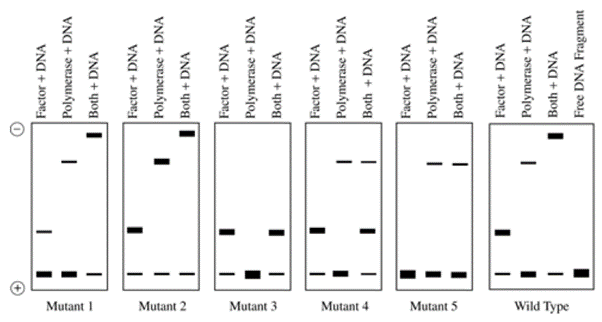
Five E. coli strains have been identified, each of which has a different mutation that disrupts the normal regulation of a particular operon. For each mutant strain, the mutation has been mapped to the promoter or the operator region; however, the exact sequence changes are not known for these mutations. It is known that the normal promoter/operator consists of a single binding site for a positively acting transcription factor located just upstream of the promoter itself. Short DNA fragments containing the promoter and the operator were subcloned from each of the five mutant strains and from the wild type, purified, and radiolabeled. These fragments were then incubated under conditions of DNA excess with either purified regulatory factor or RNA polymerase or with both polymerase and regulatory factor.

The resulting protein-DNA complexes were separated by electrophoresis, and the radioactive DNA fragments were detected by exposure to x-ray film, giving the results shown below. Electrophoresis is from top to bottom; the largest complexes run slowest.

Based on above experiment, match the following

Effect

Mutant

1. One of the mutations increases the affinity of the polymerase for the promoter. Transcription of the operon is not stimulated by the regulatory factor in this mutant.

A. Mutant 5

2. One of the mutations maps to the operator.

Transcription of the operon is not stimulated by the regulatory factor in this mutant. Which mutant is most likely to show this effect

B. Mutant 2

3. One of the mutations is known to result from a small deletion between the operator and the promoter. The polymerase and the regulatory factor is each able to bind to the mutated DNA sequence, but are unable to form the three components complex. Transcription of the operon is not stimulated by the regulatory factor in this mutant. Which mutant shows the properties that might be expected for such a change?

C. Mutant 4

D. Mutant 3

E. Mutant 1

#XL - Q Biochemistry
  1. 1B, 2A, 3C  

  2. 1E, 2B, 3C  

  3. 1B, 2A, 3D  

  4. 1B, 2E, 3C

More Questions
TLS Online TPP Program

#Question id: 3049

#XL - S Microbiology

E. coli cells typically make most of their ATP by metabolizing glucose. Under the conditions of this experiment, what should be true of E. coliʹs generation time

TLS Online TPP Program

#Question id: 3050

#XL - S Microbiology

Agar is well suited as a solidifying agent because

A. it has been melted in boiling water

B. it can be cooled to about 40 to 42°C before hardening

C. it will not melt again until the temperature rises to about 80 to 90°C.

D. most microorganisms cannot degrade it.

TLS Online TPP Program

#Question id: 3051

#XL - S Microbiology

You have 10^10 cell/L of bacterial stock solution. To prepare 1 liter of growth medium containing 1000 bacteria, the volume in microlitre of this stock solution that should be added is

TLS Online TPP Program

#Question id: 3052

#XL - S Microbiology

How many average CFU will form on petriplate if 0.1ml sample plating from 104 diluted sample (original sample contain 3x10^7 bacteria per ml)

TLS Online TPP Program

#Question id: 3053

#XL - S Microbiology

Bacterial culture contains 1000/ mL in the exponential growth phase. If you consider a generation time of 20 minutes, the total number of organisms / mL 60 minute will be

TLS Online TPP Program

#Question id: 3054

#XL - S Microbiology

A pure culture in exponential growth phase has a bacterial concentration of 6.4 x 10^8 cells/ml. If the bacterium has a generation time of 1 h, how long ago was the cell concentration 8.0 x 10^7 cells/ml?