
#Question id: 4888
#Unit 8. Inheritance Biology
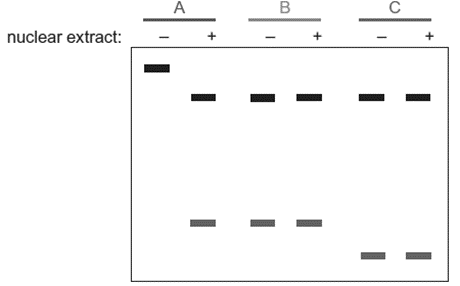
The A locus and the D locus are link with 50 % chance of crossing over observed between them. If Ad/Ad is crossed to aD/aD, and the F1 is test cross, which of the following phenotype is statement is correct?
A) Frequency of recombinant progeny is equal to parental frequency
B) Frequency of recombinant progeny is less than parental frequency
C) Distance between Locus A and B is 50 map unit
D) Distance between Locus A and B is 25 map unit
#Question id: 4887
#Unit 8. Inheritance Biology
Flower color gene incompletely link to pollen length gene at 20 map unit, Blue follower is dominant over white flower and long pollen is dominant over short pollen. A plant with Blue flower and short pollen was cross with white flower and long pollen. All F1 offspring display blue flower and long pollen was allowed to cross with white flower and short pollen. What is the percent of progeny showing blue flower and long pollen?
#Question id: 4886
#Unit 8. Inheritance Biology
Match the two columns that represent linkage strength and frequency of gametes Which of the following correct combination of linkage strength and frequency of gametes?
#Question id: 4885
#Unit 8. Inheritance Biology
In watermelons, bitter fruit (B) is dominant over sweet fruit (b), and yellow spots (S) are dominant over no spots (s). The genes for these two characteristics link at 30 map unit. A homozygous plant that has bitter fruit and yellow spots is crossed with a homozygous plant that has sweet fruit and no spots. If an F1 plant is backcrossed with the sweet fruit, no spot parent, what are the phenotypes ratio expected in the their offspring
#Question id: 4884
#Unit 8. Inheritance Biology
True breeding brown dogs with genotype aabb were cross to true breeding white dogs with genotype AABB. All F1 offspring having white phenotype were allowed to intercross to produce F2 progeny as following number –
A- - - 118 white,
aa B- 32 black
aa bb 10 brown
A Male Dog with AaBb genotype was cross with female dog with aabb genotype. What is probability of Black phenotype among their offspring if A gene link B gene at 10 map unit at cis configuration?
#Question id: 4883
#Unit 8. Inheritance Biology
Heterozygous female selected mate to a homozygous male fruit fly with yellow body color and curved wings, four types of offspring will occur
Black body, flat wings 12.5 %
Black body, curve wing 37.5 %
Yellow body, curve wing 12.5 %
Yellow body, flat wings 37.5 %
Which of the following conclusion drawn about nature of inheritance?
A) Black body, curve wing are dominant over yellow body and flat wings.
B) F2 phenotype will not show ratio of 9:3:3:1when inter cross F1 heterozygous
C) Gene for body color and wing shape is incompletely link
D) F1 hybrid genotype having cis configuration of allele