TLS Online TPP Program

#Question id: 5361


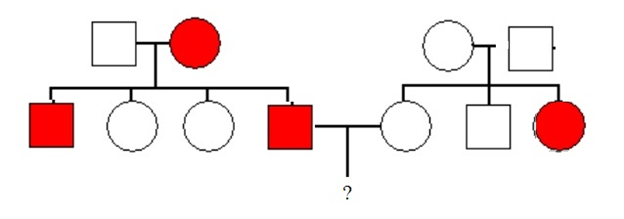
The pedigree shows the inheritance of a RFLP marker through three generations in a single family. A total of 8 alleles (numbered to the left of the blots) are present in the family. The RFLPs of each member of the family are placed directly below his (squares) or her (circles) symbol and RFLP numbers. In Above pedigree, which of the following are not children of second generation parent?

#Unit 8. Inheritance Biology
  1. A and B   

  2. D and F    

  3. A and D      

  4. E and F

More Questions
TLS Online TPP Program
#Question id: 13164

#Unit 4. Cell Communication and Cell Signaling

Match the following.

Column IColumn IIColumn III
A. G Protein–Coupled Receptors That Activate PDEi. cAMPa. Increase in conversion of glycogen to glucose
B. G Protein–Coupled Receptors That Activate Adenylyl Cyclaseii. cGMPb. Hyperpolarization or depolarization of photoreceptor membrane
C. G Protein–Coupled Receptors That inhibit Adenylyl Cyclaseiii. DAGc. activates genes necessary for cell division
D. G Protein–Coupled Receptors That Trigger Elevations in Cytosolic and Mitochondrial Calcium
d. increase in K+ permeability hyperpolarizes the membrane

Which one of the following is correct?

TLS Online TPP Program

#Question id: 13163

#Unit 4. Cell Communication and Cell Signaling

Following statements are regarding to the interaction between β2-adrenergic receptor and G- protein.

TLS Online TPP Program

#Question id: 13162

#Unit 4. Cell Communication and Cell Signaling

In the amoeba Dictyostelium discoideum, cAMP acts as an extracellular signalling molecule and binds to and signals via a G protein–coupled receptor; it is not a second messenger. Amoeba cells were transfected with genes encoding two fusion proteins: a Gα fused to cyan fluorescent protein (CFP), and a Gβ fused to yellow fluorescent protein (YFP). CFP normally fluoresces 490-nm light; YFP, 527-nm light. In which conditions fluorescence
energy transfer occur from CFP to YFP?

TLS Online TPP Program

#Question id: 13161

#Unit 4. Cell Communication and Cell Signaling

Which of the following mechanism depends on the activation of heterotrimeric G proteins?

TLS Online TPP Program

#Question id: 13160

#Unit 4. Cell Communication and Cell Signaling

According to the Switching mechanism, monomeric G proteins exist in two states. Match the following states (Column I) with correct mechanism (Column II).

Column I

Column II

A. “ON” state 

i. switch I and switch II, are bound to the terminal γ phosphate of GTP through interactions with the backbone amide groups of conserved threonine and glycine residues.

B. “OFF” state

ii. GTPase-activating proteins


iii. guanine nucleotide exchange factor


iv. Due to the removal of the γ phosphate by GTPase-catalyzed hydrolysis causes switch I and switch II to relax into a different conformation


TLS Online TPP Program

#Question id: 13159

#Unit 4. Cell Communication and Cell Signaling

How signaling is involved in ensuring that yeast cells fuse only with cells of the opposite mating type?