TLS Online TPP Program

#Question id: 7294


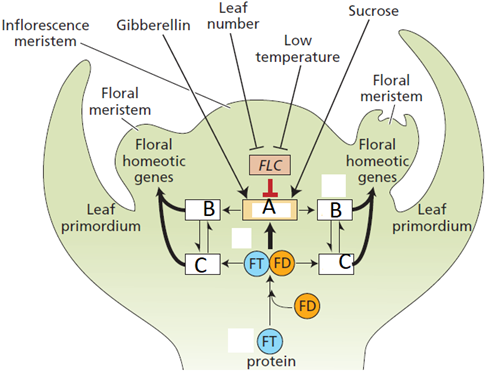
Multiple factors regulate flowering in Arabidopsis. FT mRNA is expressed in companion cells of the leaf vein in response to multiple signals, including day length, light quality, and temperature. FT moves in the phloem from leaves to the apical meristem. FT is unloaded from the phloem in the meristem and interacts with FD.

FT-FD complex activates multiple genes. Which of the following combination is correct?(SS)

#Unit 5. Developmental Biology
  1. A-LFY, B-AP1, C-SOC1
  2. A-AP1, B-LFY, C-SOC1
  3. A-SOC1, B-LFY, C-AP1
  4. A-SOC1, B-AP1, C-LFY
More Questions
TLS Online TPP Program
#Question id: 10357

#Unit 6. System Physiology – Plant

Why the glutamine and glutamate will not be transported while  asparagine will prefer to be transported?

TLS Online TPP Program

#Question id: 10358

#Unit 6. System Physiology – Plant

Which of the following essential micronutrients is associated with nitrate reductase enzyme found in higher plants?

TLS Online TPP Program

#Question id: 10359

#Unit 6. System Physiology – Plant

Nitrate reductases of higher plants are composed of two identical subunits, each containing three prosthetic groups. Which of the following is not the prosthetic group of nitrate reductase;

TLS Online TPP Program

#Question id: 10360

#Unit 6. System Physiology – Plant

How much ATP require in the nitrogen fixation or conversion of ammonium assimilation in the system?

TLS Online TPP Program

#Question id: 10361

#Unit 6. System Physiology – Plant

The carbon skeleton for amino acids derives from 3-phosphoglycerate generated during glycolysis is called anaplueratic reaction. Generated amino acids from 3-PGA is that,

TLS Online TPP Program

#Question id: 10362

#Unit 6. System Physiology – Plant

Bacteria can convert atmospheric nitrogen into ammonia, Several form symbiotic associations with higher plants is given below;

               HOST PLANT                                                                          N-FIXING SYMBIONTS

A) Gunnera                                                                            i) Frankia

      B) Azolla                                                                                ii) Acetobacter

C) Leguminous                                                                     iii) Azospirillum

             D) Actinorhizal                                                                      iv) Nostoc

             E) Sugarcane                                                                         v) Anabaena

             F) Miscanthus                                                                       vi) Sinorhizobium


Which of the following combination with the host plants and n-fixing symbionts is CORRECT?