TLS Online TPP Program

#Question id: 2915


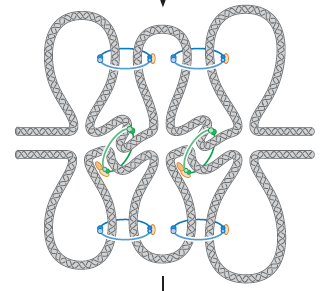
The structural maintenance of chromosome (SMC) proteins are extended proteins that form defined pairs by interacting through lengthy coiled-coil domains. Together with non-SMC proteins, they form multiprotein complexes that act to link two DNA helices together. Identify the SMC proteins in the figure given below and match them with their respective subunits.

i. Blue – Cohesin made up of Smc 1 and Smc 2 proteins.

ii. Green – Condensin made up of Smc 3 and Smc 4 proteins.

iii. Blue – Condensin made up of Smc 2 and Smc 4 proteins.

iv. Green – Cohesins made up of Smc 1 and Smc 3 proteins.

v. Blue – Condensin made up of Smc 1 and Smc 3 proteins.

vi. Green – Cohesins made up of Smc 2 and Smc 4 proteins.

#Unit 2. Cellular Organization
  1. Statement v and vi are correct

  2. Statement iii and vi are correct

  3. Statement ii and v are correct

  4. Statement iii and iv are correct

More Questions
TLS Online TPP Program
#Question id: 12303

#Unit 7. System Physiology – Animal

Which of the following changes would you expect to find in a dehydrated person deprived of water for 24 hours?

TLS Online TPP Program

#Question id: 12304

#Unit 7. System Physiology – Animal

Which of the following changes would you expect to find after acute administration of a vasodilator drug that caused a 50% decrease in renal efferent arteriolar resistance and no change in afferent arteriolar resistance or arterial pressure? 

TLS Online TPP Program

#Question id: 12305

#Unit 7. System Physiology – Animal

Which of the following would be expected to cause a decrease in extracellular fluid potassium concentration (hypokalemia) at least in part by stimulating potassium uptake into the cells?

TLS Online TPP Program

#Question id: 12306

#Unit 7. System Physiology – Animal

 Which of the following is true of the tubular fluid that passes through the lumen of the early distal tubule in the region of the macula densa?

TLS Online TPP Program

#Question id: 12307

#Unit 7. System Physiology – Animal

If a person has a kidney transport maximum for glucose of 350 mg/min, a GFR of 100 ml/min, a plasma glucose of 150 mg/dL, a urine flow rate of 2 ml/min, and no detectable glucose in the urine, what would be the approximate rate of glucose reabsorption, assuming normal kidneys?

TLS Online TPP Program

#Question id: 12308

#Unit 7. System Physiology – Animal

 Which of the following statements is correct?