TLS Online TPP Program

#Question id: 3815


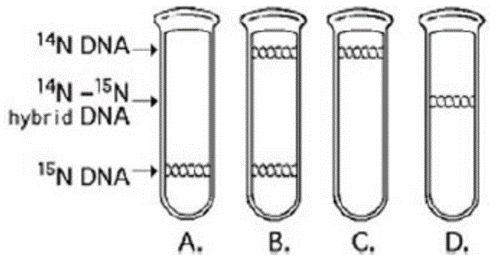
Use the figure to answer the following question. A space probe returns with a culture of a microorganism found on a distant planet. Analysis shows that it is a carbon-based life-form that has DNA. You grow the cells in 15N medium for several generations and then transfer them to 14N medium. Which pattern in the figure would you expect if the DNA was replicated in a conservative manner?

#Unit 3. Fundamental Processes
  1. A

  2. B

  3. C

  4. D

More Questions
TLS Online TPP Program

#Question id: 12693

#Unit 8. Inheritance Biology

A panel of cell lines was created by human-mouse cell line hybridization. Each line was examined for the presence of  human chromosome and for the gene production. The following result were obtained;
On the basis of these results, which chromosome has the gene  that encodes the enzyme ?

TLS Online TPP Program

#Question id: 12694

#Unit 8. Inheritance Biology

A panel of cell lines was created by human—mouse somatic-cell hybridization. Each line was examined for the presence of human chromosomes and for the production of an enzyme. The following results were obtained: 

On the basis of these results, which chromosome has the gene that encodes the enzyme? 

TLS Online TPP Program

#Question id: 12695

#Unit 8. Inheritance Biology

A panel of cell lines was created by human—mouse somatic-cell hybridization. Each cell line was examined for the presence of human chromosomes and for the production of three enzymes. The following results were obtained: 

On the basis of these results, give the chromosomal locations of the genes encoding enzyme 1, enzyme 2, and enzyme 3. 

TLS Online TPP Program

#Question id: 12696

#Unit 8. Inheritance Biology

The following is a schematic representation of region of the chromosome of fly along with extent of six deletions (Del 1 to Del 6); 
When flies homozygous for the recessive mutations are crossed with flies heterozygous for the deletions, the following results are obtained, in which "m" represents a mutant phenotype and a plus sign (+) represents the wild type. On the basis of these data, determine the relative order of the seven mutant eenes on the chromosome. 

TLS Online TPP Program

#Question id: 12697

#Unit 7. System Physiology – Animal

The following test results were obtained: urine flow rate = 2.0 ml/min; urine inulin concentration = 60 mg/ml; plasma inulin concentration = 2 mg/ml; urine potassium concentration = 20 μmol/ml; plasma potassium concentration = 4.0 μmol/ml; urine osmolarity = 150 mOsm/L; and plasma osmolarity = 300 mOsm/L. What is the approximate GFR?

TLS Online TPP Program

#Question id: 12698

#Unit 7. System Physiology – Animal

The following test results were obtained: urine flow rate = 2.0 ml/min; urine inulin concentration = 60 mg/ml; plasma inulin concentration = 2 mg/ml; urine potassium concentration = 20 μmol/ml; plasma potassium concentration = 4.0 μmol/ml; urine osmolarity = 150 mOsm/L; and plasma osmolarity = 300 mOsm/L. What is the net potassium reabsorption rate?