TLS Online TPP Program

#Question id: 1386


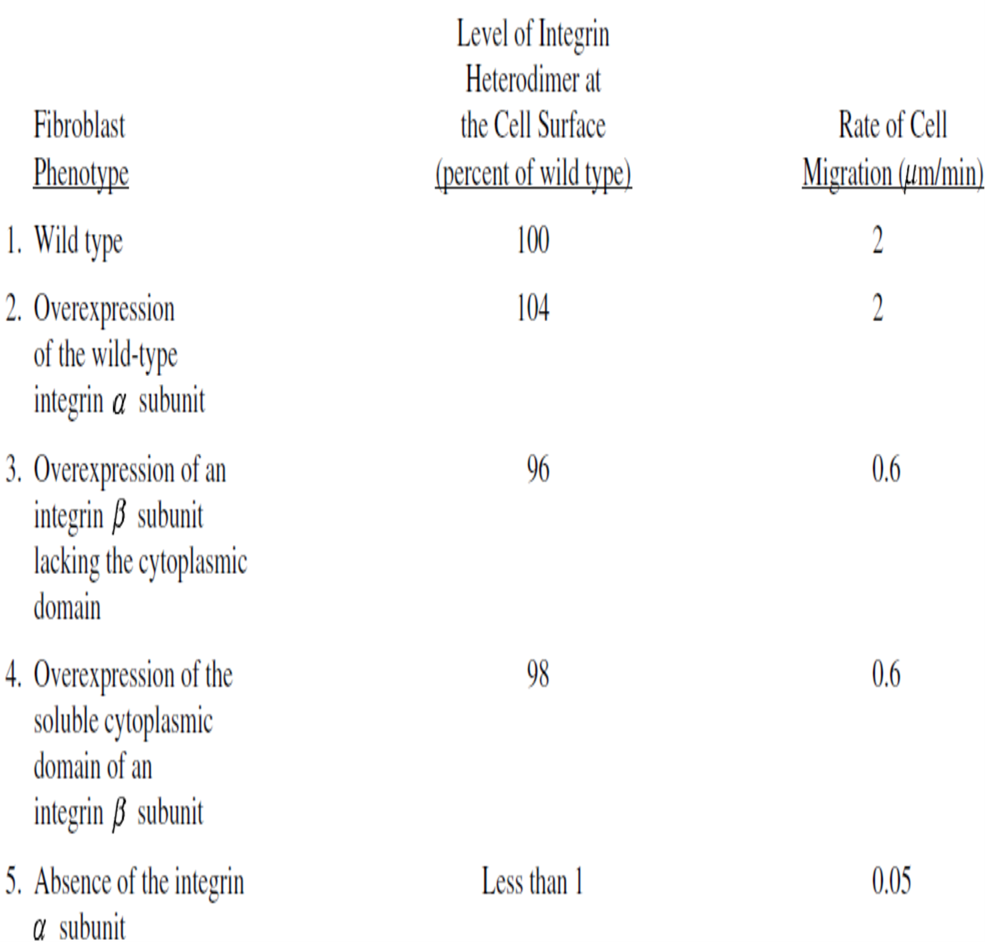
The ability of a population of fibroblasts to migrate along the surface of a tissue culture dish depends on adhesion between the cell surface and the extracellular matrix molecules coating the dish. The dish is coated with laminin, and the only cell-surface protein capable of binding laminin is a cell-adhesion protein called an integrin. Integrins are integral plasma-membrane proteins that function as heterodimers. Under these conditions the rate at which a fibroblast can migrate along the laminin coated culture dish is proportional to the strength of adhesion between the cell and the laminin substrate. The table below lists the rate of cell migration observed for fibroblasts genetically engineered to generate the indicated phenotypes. One explanation for the effect of overexpression of the cytoplasmic domain of the integrin beta subunit is that this domain normally functions to bind a cytoplasmic factor necessary for integrin function. Which of the following would be the most informative experiment to identify the cytoplasmic factor?

#Unit 4. Cell Communication and Cell Signaling
  1. Fractionate a fibroblast cell extract using an affinity column prepared with the cytoplasmic domain of the beta integrin subunit.

  2. Fractionate a fibroblast cell extract using an affinity column prepared with the integrin beta subunit lacking the cytoplasmic domain.

  3. Inject live fibroblasts with the cytoplasmic domain of the integrin beta subunit.

  4. Inject live fibroblasts with an antibody to the cytoplasmic domain of the integrin beta subunit.

More Questions
TLS Online TPP Program
#Question id: 9591

#Unit 6. System Physiology – Plant

In light reaction, the funneling of excitation from the antenna system toward the reaction centre has been shown,

a.) The excited-state energy of pigments increases with distance from the reaction centre; that is, pigments closer to the reaction centre are lower in energy than those farther from the reaction centre

b.) The energy gradient ensures that excitation transfer toward the reaction centre is energetically favorable and that excitation transfer back out to the peripheral portions of the antenna is energetically unfavourable

c.) Some energy is lost as heat to the environment by this process, but under optimal conditions almost all the excitation energy absorbed in the antenna complexes can be delivered to the reaction centre

d.) The excited-state energy of  pigments decreases with distance from the reaction centre

Which of the following above combination is true?

TLS Online TPP Program

#Question id: 9587

#Unit 6. System Physiology – Plant

The structure of the four major protein complexes in the thylakoid membrane are organised form such as ;

a.) PSII is located predominantly in the stacked regions of the thylakoid membrane and Cytochrome b6f complexes are evenly distributed

b.) PSI and ATP synthase are found in the unstacked regions protruding into the stroma

c.) Lateral separation of the two photosystems requires that electrons and protons produced by PSII be transported directly to PSI and the ATP coupling enzyme

d.) Four main protein complexes of the thylakoid membrane, shown also are the two diffusible electron carriers—plastocyanin, which is located in the thylakoid lumen, and plastohydroquinone (PQH2) in the membrane, The lumen has a positive electrical charge with respect to the stroma

Which of the following statements correct?

TLS Online TPP Program

#Question id: 9582

#Unit 6. System Physiology – Plant

Electrons ejected from chlorophyll travel through a series of electron carriers organized in the “Z Scheme” shows a current version of the Z scheme, in which all the electron carriers known to function in electron flow from H2O to NADP Presented in the following sequence;

a.) P680 reduce by Yz has received electrons from oxidation of water P680→P680*→pheophytinplastoquinones→ cytochrome b6 f complex→ plastocyanin→ in turn reduces (PSI) P700+

b.) P700+→ P700*→ membrane-bound iron–sulfur proteins → A0→ A1 → flavoprotein ferredoxin–NADP reductase (FNR) soluble → ferredoxin(Fd) → NADP+ to NADPH

c.) P700+→ P700*→ A0→ A1→ membrane-bound iron–sulfur proteins→ ferredoxin(Fd)→ soluble flavoprotein ferredoxin–NADP reductase (FNR)→ NADP+ to NADPH

d.) P680 reduce by Yz has received electrons from oxidation of water P680→P680*→ plastoquinonespheophytin → cytochrome b6 f complex→ plastocyanin→ in turn reduces (PSI) P700+

Which one of the following combinations is correct?

TLS Online TPP Program

#Question id: 9581

#Unit 6. System Physiology – Plant

These four Photosystem II, Cytochrome b6 f, Photosystem I and ATP synthase integral membrane complexes are vectorially oriented in the thylakoid membrane to function as follows, find out the incorrect statements;

TLS Online TPP Program

#Question id: 9284

#Unit 6. System Physiology – Plant

Following are some facts regarding spatial separation of PSI and PSII. Which one would be INCORRECT?

TLS Online TPP Program

#Question id: 9283

#Unit 6. System Physiology – Plant

Organization of the protein complexes the photosystems I and II Are spatially separated in the thylakoid membrane, choose the correct arrangement of PSI and PSII on the membrane ;

a.) The PSI reaction centre and its associated antenna pigments and electron transfer proteins, as well as the coupling-factor enzyme that catalyzes the formation of ATP, are found almost exclusively in the stroma lamellae and at the edges of the grana lamellae

b.) The PSI reaction centre, along with its antenna chlorophylls and associated electron transport proteins, is located predominantly in the stromal lamellae

c.) The PSII reaction centre and its associated antenna pigments and electron transfer proteins, as well as the coupling-factor enzyme that catalyzes the formation of ATP, are found almost exclusively in the stroma lamellae and at the edges of the grana lamellae

d.) The PSII reaction centre, along with its antenna chlorophylls and associated electron transport proteins, is located predominantly in the grana lamellae

Which of the following given combination correct?