TLS Online TPP Program

#Question id: 16127


You are studying regulation of the yeast enzyme glutamine synthetase (GS), which is encoded by the GLN1 gene. You have isolated two mutants, designated  gln2– and gln3–, that give decreased GS activity. Mating of either gln2– or gln3– haploids to wild type produces heterozygous diploids that show normal amounts of GS expression. When you cross either a gln2– or gln3– haploid to a gln1– strain the resulting diploids show normal expression of GS.
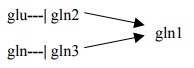
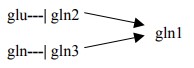
The GLN1 gene shows a rather complex regulation in response to different amino acids. When either glutamate (glu) or glutamine (gln) is added to the medium, the amount of GS expression diminished and when both glutamate and glutamine are added to the medium GS expression is shut off completely. The effects of different mutants on the response to glu and gln are shown below.
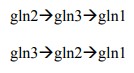
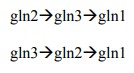
Which of the models from best fits these experimental results? Complete the model for the regulation of GLN1 that includes the effects of glu and gln.      

#Unit 13. Methods in Biology
  1. Parallel model best fits the experimental results, addition of glutamate (glu) and glutamine (gln) dependently regulate the GS activity
  2. Parallel model best fits the experimental results, addition of glutamate (glu) and glutamine (gln) independently regulate the GS activity
  3. linear model best fits the experimental results, addition of glutamate (glu) and glutamine (gln) dependently regulate the GS activity
  4. linear model best fits the experimental results, addition of glutamate (glu) and glutamine (gln) independently regulate the GS activity
More Questions
TLS Online TPP Program

#Question id: 13139

#Unit 10. Ecological Principles

The logistic equation above is used to describe the rate of change of a population, N, with time, t, where r is the intrinsic rate of increase and K is the carrying capacity. Which of the following statements is true for this equation?

TLS Online TPP Program

#Question id: 13140

#Unit 10. Ecological Principles

One summer the moose population on Island was unusually high, and park naturalists noticed signs of malnutrition among the  adults.  The wolf population  was  fairly  low,  near  20.  That  winter,  for  the  first  time  in  many  years,  a substantial  number of seemingly healthy adult moose as well as calves and crippled animals were killed and eaten by wolves. This description is part of a general situation in which the wolf and moose populations

TLS Online TPP Program

#Question id: 13141

#Unit 10. Ecological Principles

Five similar populations of a herbaceous annual plant are monitored for three years; then, the numbers of individuals in populations I-IV are increased by an experimenter. Subsequent changes in the sizes of all the populations are shown in the graph below.

If size distributions of individuals do not vary among these populations, which of the following relationships best illustrates the occurrence of population regulation?

TLS Online TPP Program

#Question id: 13142

#Unit 10. Ecological Principles

The Norway rat (Rattus Norvegicus), a widespread pest, was controlled for about a decade by the anticoagulant warfarin. This chemical substance, placed in food pellets, is absorbed by the intestinal tract and inhibits the clotting of blood. After a population decline for about 10 years, rat populations increased and stabilized. In one European population, as illustrated in the graph below, the percentage of rats resistant to warfarin has remained fairly stable over a number of years.

Resistance to warfarin is governed by a dominant autosomal gene, R. More than 15 percent of the resistant animals are heterozygous at this locus (Rr). The table below indicates the response to warfarin and relative reproductive fitness of individuals that are homozygous or heterozygous for the dominant gene (R). The RR individuals have a 20-fold increase in vitamin K requirement over individuals.

Fitness is a measure of the reproductive success of a particular genotype. The highest fitness is 1.00.
There is a substantial number of heterozygotes in the population. Which of the following is the best explanation of this observation?

TLS Online TPP Program

#Question id: 13143

#Unit 10. Ecological Principles

The Norway rat (Rattus Norvegicus), a widespread pest, was controlled for about a decade by the anticoagulant warfarin. This chemical substance, placed in food pellets, is absorbed by the intestinal tract and inhibits the clotting of blood. After a population decline for about 10 years, rat populations increased and stabilized. In one European population, as illustrated in the graph below, the percentage of rats resistant to warfarin has remained fairly stable over a number of years.

Resistance to warfarin is governed by a dominant autosomal gene, R. More than 15 percent of the resistant animals are heterozygous at this locus (Rr). The table below indicates the response to warfarin and relative reproductive fitness of individuals that are homozygous or heterozygous for the dominant gene (R). The RR individuals have a 20-fold increase in vitamin K requirement over individuals.

Fitness is a measure of the reproductive success of a particular genotype. The highest fitness is 1.00.
In a population where warfarin is no longer applied, the expectation is that the

TLS Online TPP Program

#Question id: 13168

#Unit 10. Ecological Principles

Use the following diagram from the text showing the spread of the cattle egret, Bulbulcus ibis, since its arrival in the New World, to answer the following question.


How would an ecologist likely explain the expansion of the cattle egret?