TLS Online TPP Program

#Question id: 4099


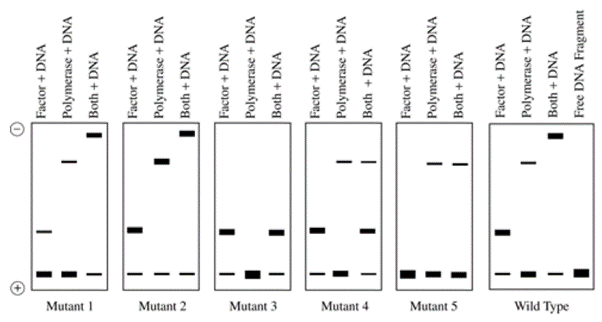
Five E. coli strains have been identified, each of which has a different mutation that disrupts the normal regulation of a particular operon. For each mutant strain, the mutation has been mapped to the promoter or the operator region; however, the exact sequence changes are not known for these mutations. It is known that the normal promoter/operator consists of a single binding site for a positively acting transcription factor located just upstream of the promoter itself. Short DNA fragments containing the promoter and the operator were subcloned from each of the five mutant strains and from the wild type, purified, and radiolabeled. These fragments were then incubated under conditions of DNA excess with either purified regulatory factor or RNA polymerase or with both polymerase and regulatory factor.

The resulting protein-DNA complexes were separated by electrophoresis, and the radioactive DNA fragments were detected by exposure to x-ray film, giving the results shown below. Electrophoresis is from top to bottom; the largest complexes run slowest.

Based on above experiment, match the following

Effect

Mutant

1. One of the mutations increases the affinity of the polymerase for the promoter. Transcription of the operon is not stimulated by the regulatory factor in this mutant.

A. Mutant 5

2. One of the mutations maps to the operator.

Transcription of the operon is not stimulated by the regulatory factor in this mutant. Which mutant is most likely to show this effect

B. Mutant 2

3. One of the mutations is known to result from a small deletion between the operator and the promoter. The polymerase and the regulatory factor is each able to bind to the mutated DNA sequence, but are unable to form the three components complex. Transcription of the operon is not stimulated by the regulatory factor in this mutant. Which mutant shows the properties that might be expected for such a change?

C. Mutant 4

D. Mutant 3

E. Mutant 1

#Unit 3. Fundamental Processes
  1. 1B, 2A, 3C  

  2. 1E, 2B, 3C  

  3. 1B, 2A, 3D  

  4. 1B, 2E, 3C

More Questions
TLS Online TPP Program

#Question id: 2837

#Unit 2. Cellular Organization

The C-terminal activation domain of transcriptional activators is capable of
a. binding to DNA.                 
b. stimulating transcription.
c. interaction with other transcriptional machinery.
d. functioning in a fusion with a DNA-binding domain from an unrelated transcriptional activator.

TLS Online TPP Program

#Question id: 2838

#Unit 2. Cellular Organization

You want to study the potential interaction between nucleosome-bound DNA and a specific histone deacetylase. You decide to perform an electrophoretic mobility shift assay (EMSA). You use a 32P end-labelled, linear template DNA that contains two nucleosome positioning sites. You assemble two nucleosomes on the DNA template before incubation with and without the histone deacetylase. For some reactions, you use unmodified nucleosomes. For other reactions, you use nucleosomes that are methylated at lysine 36 of the histone protein H3.

A. The histone deacetylase binds nucleosome bound-DNA in lanes 1, 2, 3, and 4.

B. The histone deacetylase binds nucleosome bound-DNA in lanes 3& 4.

C. The histone deacetylase seems to recognize methylated nucleosomes at lysine 36 of histone H3 in lane 1, 2 & 3 better than unmethylated nucleosomes in lane 4 &5

D. The histone deacetylase seems to recognize methylated nucleosomes at lysine 36 of histone H3 in lane 1 & 2 better than unmethylated nucleosomes in lane 3 &4

TLS Online TPP Program

#Question id: 2839

#Unit 2. Cellular Organization

Consider for correct match

I. All the different members of family of genes and proteins are sufficiently similar in sequence to suggest a common ancestral sequence.

A. Homologous

II. Sequences that presumably diverged as a result of gene duplication

B. Paralogous

III. Sequences that arose because of speciation

C. Orthologous

TLS Online TPP Program

#Question id: 2840

#Unit 2. Cellular Organization

An experimental setup provided the assay for identifying factors that facilitate transcription in the presence of chromatin. A factor called FACT (facilitates chromatin transcription) functions as 

TLS Online TPP Program

#Question id: 2841

#Unit 2. Cellular Organization

To duplicate a chromosome, at least half of the nucleosomes on the daughter chromosomes must be newly synthesized. But histone proteins as new and old occupies strands differently as

TLS Online TPP Program

#Question id: 2842

#Unit 2. Cellular Organization

Epigentic code for inactive X chromosome have post-translational modifications characteristic of other regions of heterochromatin as