TLS Online TPP Program

#Question id: 4103


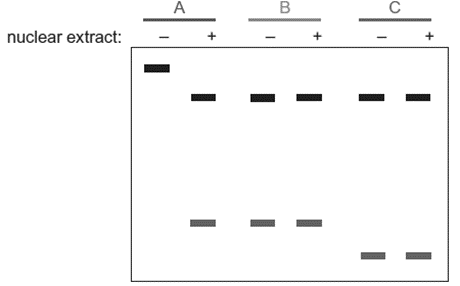
In a biochemical experiment, you compare the products from splicing reactions carried out in vitro using three different substrates. In each case the substrate is a construct containing a single intron surrounded by two exons, and in all cases the construct is the same overall size. But in one case, the intron is a group I intron, in another a group II intron, and in the third an intron removed by the spliceosome. Each construct is labelled in a manner that allows it to be detected after gel electrophoresis, and each is tested in two reactions—one, conditions that support self-splicing, and two, in the presence of nuclear extract as well. Note that, for simplification, only the final products of the splicing reaction are seen, but before degradation of the introns.

 Which of the following observation is/are correct?

A. In lane A, the presence of nuclear abstract, a band for the lariat and the spliced product and pre-mRNA.

B. Lane B shows Group I Introns and Lane C is for Group II introns and reaction is nonself-splicing

C. Lane C is Group I intron. Splicing takes place in the absence and presence of nuclear abstract, and the reaction is self-splicing.

#Unit 3. Fundamental Processes
  1. A only

  2. B & C only   

  3. A, B & C   

  4. A & C only

More Questions
TLS Online TPP Program

#Question id: 4711

#Unit 11. Evolution and Behavior

Starting from the wild mustard Brassica oleracea, breeders have created the strains known as Brussels sprouts, broccoli, kale, and cabbage. Therefore, which of the following statements is correct?

TLS Online TPP Program

#Question id: 4712

#Unit 11. Evolution and Behavior

Which of these conditions are always true of populations evolving due to natural selection? Condition 1: The population must vary in traits that are heritable.

Condition 2: Some heritable traits must increase reproductive success.

Condition 3: Individuals pass on most traits that they acquire during their lifetime.

TLS Online TPP Program

#Question id: 4713

#Unit 11. Evolution and Behavior

A farmer uses triazine herbicide to control pigweed in his field. For the first few years, the triazine works well and almost all the pigweed dies; but after several years, the farmer sees more and more pigweed. Which of these statements explains why the pigweed reappeared?

TLS Online TPP Program

#Question id: 4714

#Unit 11. Evolution and Behavior

After the drought of 1977, researchers hypothesized that on the Galápagos Island Daphne Major, medium ground finches with large, deep beaks survived better than those with smaller beaks because they could more easily crack and eat the tough Tribulus cistoides fruits. A tourist company sets up reliable feeding stations with a variety of bird seeds (different types and sizes) so that tourists can get a better look at the finches. Which of these events is now most likely to occur to finch beaks on this island?

TLS Online TPP Program

#Question id: 4715

#Unit 11. Evolution and Behavior

Claytonia virginica is a woodland spring herb with flowers that vary from white, to pale pink, to bright pink. Slugs prefer to eat pink-flowering over white-flowering plants (due to chemical differences between the two), and plants experiencing severe herbivory are more likely to die. The bees that pollinate this plant also prefer pink to white flowers, so that Claytonia with pink flowers have greater relative fruit set than Claytonia with white flowers. A researcher observes that the percentage of different flower colors remains stable in the study population from year to year. Given no other information, if the researcher removes all slugs from the study population, what do you expect to happen to the distribution of flower colors in the population over time?

TLS Online TPP Program

#Question id: 4716

#Unit 11. Evolution and Behavior

Which of the following is correct match?

A

Wallace

I

Changes in allele frequency due

to random genetic drift

B

Sewall Wright

II

Evolution by natural selection

C

Carl Woese

III

hybrid sterility

D

Haldane’s rule

IV

DNA sequencing led to molecular phylogenetics