TLS Online TPP Program

#Question id: 4643


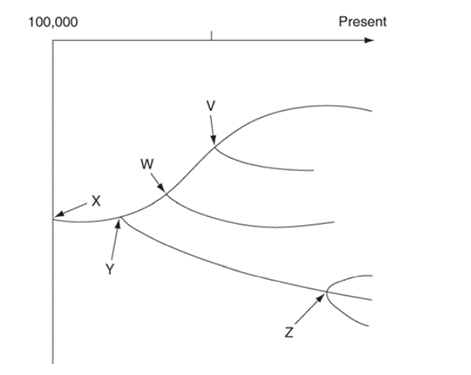
The treeʹs horizontal axis is a timeline that extends from 100,000 years ago to the present; the vertical axis represents nothing in particular. The labeled branch points on the tree (V—Z) represent various common ancestors. Letʹs say that only since 50,000 years ago has there been enough variation between the lineages depicted here to separate them into distinct species, and only the tips of the lineages on this tree represent distinct species.

How many separate species, both extant and extinct, are depicted in this tree?

#Unit 11. Evolution and Behavior
  1. 2

  2. 3

  3. 6

  4. 5

More Questions
TLS Online TPP Program

#Question id: 10626

#Unit 10. Ecological Principles

Following is a hypothetical life table of species.


Following some statement is given

A- Proportional of survive is constant over different age group

B- Greater mortality in young age

C. Follow type II survivorship curve

D. Follow type III survivorship curve

Which of the following above statement is correct?

TLS Online TPP Program

#Question id: 10627

#Unit 10. Ecological Principles

Following graph represent mortality rate of population of species A, B and C with their respective Age


There are following organism are correct

TLS Online TPP Program

#Question id: 10628

#Unit 10. Ecological Principles

Which of following statement is correct for above population?


TLS Online TPP Program

#Question id: 10629

#Unit 10. Ecological Principles

Following are density dependent factors

A- Food                            B- space

Which of the following animal and their most important density dependent limiting factor are correct?

TLS Online TPP Program

#Question id: 10630

#Unit 10. Ecological Principles

Following is relation between population size with various strategies of species, following is correct figure? 


TLS Online TPP Program

#Question id: 10631

#Unit 10. Ecological Principles

To estimate the number of foxes m an area, a researcher conducted a mark-recapture survey. In the fast survey, he caught and marked 90 foxes. In his second survey a week later, he caught 120 foxes of which 40 were marked (recaptures). If you are told that the actual number of foxes in this area is 400, which of the following is a plausible explanation for the anomaly in the researcher's data?