TLS Online TPP Program

#Question id: 5298


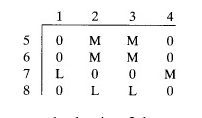
Four E. coli strains of genotype a+ b− are labeled 1, 2, 3, and 4. Four strains of genotype a− b+ are labeled 5, 6, 7, and 8. The two genotypes are mixed in all possible combinations and (after incubation) are plated to determine the frequency of a+ b+ recombinants. The following results are obtained, where M = many recombinants, L = low numbers of recombinants, and 0 = no recombinants. On the basis of these results, assign a sex type (either Hfr, F+, or F−) to each strain

#Unit 8. Inheritance Biology
  1. Thus strains 2, 3, 4 and 7 are F−. Strains 1 and 8 are F+, and strains 5, and 6 are Hfr.

  2. Thus strains  3, and 7 are F−. Strains 1, 2 and 8 are F+, and strains 4, 5, and 6 are Hfr.

  3. Thus strains 2, 3, and 7 are F−. Strains 1, 6 and 8 are F+, and strains 4 and 5 are Hfr.

  4. Thus strains 2, 3, and 7 are F−. Strains 1 and 8 are F+, and strains 4, 5, and 6 are Hfr.

More Questions
TLS Online TPP Program

#Question id: 18081

#Unit 8. Inheritance Biology

The interaction of selection and inbreeding in determining the incidence of autosomal recessive diseases. Consider a gene in which recessive mutations occur at a rate of 10-5. Assume a selective disadvantage S of 0.4 in homozygotes for the recessive allele. What is the frequency of the recessive allele (q). And calculate the incidence of the disease. Assume random mating.

TLS Online TPP Program

#Question id: 18082

#Unit 8. Inheritance Biology

The interaction of selection and inbreeding in determining the incidence of autosomal recessive diseases. Consider a gene in which recessive mutations occur at a rate of 10-5. Assume a selective disadvantage S of 0.4 in homozygotes for the recessive allele. Now assume that, for thousands of generations, 10% of all children have been products of first-cousin matings (the remaining 90% being products of random matings). Calculate the steady-state value of q. Also calculate the incidence of the disease at steady state. 

TLS Online TPP Program

#Question id: 18083

#Unit 8. Inheritance Biology

The interaction of selection and inbreeding in determining the incidence of autosomal recessive diseases. Consider a gene in which recessive mutations occur at a rate of 10-5. Assume a selective disadvantage S of 0.4 in homozygotes for the recessive allele. Would q be expected to rise, fall, or remain unchanged during the first 10 generations after the cessation of inbreeding, Briefly justify your answer. What numerical value would q approach after thousands of generations with no inbreeding?

TLS Online TPP Program

#Question id: 18087

#Unit 13. Methods in Biology

Each of five questions on a multiple-choice examination has four choices, only one of which is correct. The student is attempting to guess the answers. The random variable X is the number of questions answer correctly. Probability that the student will get
Exactly three correct answers

TLS Online TPP Program

#Question id: 18088

#Unit 13. Methods in Biology

If a coin is tossed 5 times, then consider the following statements:
I: Probability of getting exactly 2 heads is 5/16.
II: Probability of getting at least 4 heads is 3/16.
III: Probability of getting at most 2 heads is 5/8.
Which one of the following is correct in respect of the above statements

TLS Online TPP Program

#Question id: 18219

#Unit 1. Molecules and their Interaction Relevant to Biology

Pseudoknot loop refers to