TLS Online TPP Program

#Question id: 5731


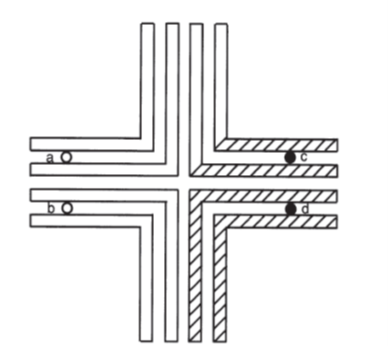
If an individual is heterozygous for this translocation, the consequence in meiosis will be as follows:

A) Segregation results in a + c in one Gametes and b + d in another gametes, have duplication and deficiency so unable to produce viable offspring

B) Segregation results in a + b in one Gametes and c + d in another gametes, have normal chromosome so all viable offspring produced

C) Segregation results in a + d in one Gametes with normal chromosome and b + c in another gametes contains translocation arrangement, all viable offspring produced

D) Segregation results in a + d in one Gametes with normal chromosome, will produced viable offspring while b + c in another gametes contains translocation arrangement, will produce non viable offspring.

#Unit 8. Inheritance Biology
  1. A and B      

  2. A and D         

  3. A and C                        

  4. B and D

More Questions
TLS Online TPP Program

#Question id: 558

#Unit 1. Molecules and their Interaction Relevant to Biology

In a plot of l/V against 1/[S] for an enzyme-catalyzed reaction, the presence of a competitive inhibitor will alter the:

TLS Online TPP Program

#Question id: 559

#Unit 1. Molecules and their Interaction Relevant to Biology

In competitive inhibition, an inhibitor:

TLS Online TPP Program

#Question id: 560

#Unit 1. Molecules and their Interaction Relevant to Biology

Vmax for an enzyme-catalyzed reaction:

TLS Online TPP Program

#Question id: 561

#Unit 1. Molecules and their Interaction Relevant to Biology

Enzyme X exhibits maximum activity at pH = 6.9.  X shows a fairly sharp decrease in its activity when the pH goes much lower than 6.4.  One likely interpretation of this pH activity is that:

TLS Online TPP Program

#Question id: 562

#Unit 1. Molecules and their Interaction Relevant to Biology

Phenyl-methane-sulfonyl-fluoride (PMSF) inactivates serine proteases by binding covalently to the catalytic serine residue at the active site; this enzyme-inhibitor bond is not cleaved by the enzyme.  This is an example of what kind of inhibition?

TLS Online TPP Program

#Question id: 563

#Unit 1. Molecules and their Interaction Relevant to Biology

Both water and glucose share an —OH that can serve as a substrate for a reaction with the terminal phosphate of ATP catalyzed by hexokinase.  Glucose, however, is about a million times more reactive as a substrate than water.  The best explanation is that: