TLS Online TPP Program

#Question id: 5648


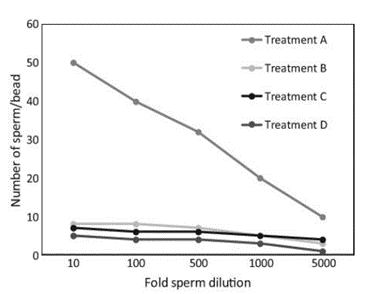
Use the following information to answer the question. In order to test how sea urchin sperm bind to eggs, scientists isolated the egg receptor protein that binds to the sperm acrosomal protein called bindin. Plastic beads were coated with egg receptor for bindin (ERB1) from eggs of the sea urchin Strongylocentrotus purpuratus, and then the beads mixed with sperm from S. purpuratus or from the related species, S. franciscanus. The researchers counted how many sperm were bound to each bead. The results are shown in the graph below. Treatments:

A: S. purpuratus sperm mixed with S. purpuratus ERB1 beads

B: S. purpuratus sperm mixed with beads containing no ERB1 protein

C: S. franciscanus sperm mixed with S. purpuratus ERB1 beads

D: S. franciscanus sperm mixed with beads containing no ERB1 protein

 What is a broader implication from the observations of the experiment?

#Unit 5. Developmental Biology
  1. In sea urchins, fertilization of eggs by sperm is dependent upon species-specific protein interactions.

  2. Only some species of sea urchins use receptor proteins on their eggs to bind sperm.

  3. Protein-coated plastic beads should not be used to test sperm binding to eggs.

  4. S. franciscanus is probably not a sea urchin, but must be some other type of organism.

More Questions
TLS Online TPP Program

#Question id: 10360

#Unit 6. System Physiology – Plant

How much ATP require in the nitrogen fixation or conversion of ammonium assimilation in the system?

TLS Online TPP Program

#Question id: 10361

#Unit 6. System Physiology – Plant

The carbon skeleton for amino acids derives from 3-phosphoglycerate generated during glycolysis is called anaplueratic reaction. Generated amino acids from 3-PGA is that,

TLS Online TPP Program

#Question id: 10362

#Unit 6. System Physiology – Plant

Bacteria can convert atmospheric nitrogen into ammonia, Several form symbiotic associations with higher plants is given below;

               HOST PLANT                                                                          N-FIXING SYMBIONTS

A) Gunnera                                                                            i) Frankia

      B) Azolla                                                                                ii) Acetobacter

C) Leguminous                                                                     iii) Azospirillum

             D) Actinorhizal                                                                      iv) Nostoc

             E) Sugarcane                                                                         v) Anabaena

             F) Miscanthus                                                                       vi) Sinorhizobium


Which of the following combination with the host plants and n-fixing symbionts is CORRECT?

TLS Online TPP Program

#Question id: 10363

#Unit 6. System Physiology – Plant

Free living nitrogen fixing takes place as shown in the following;

             TYPE                                                                                       N-FIXING GENERA

A) Cyanobacteria (blue-green algae)                                        i) Bacillus

B) Aerobic                                                                                     ii) Clostridium

C) Facultative                                                                              iii) Anabaena

D) Anaerobic nonphotosynthetic                                            iv) Rhodospirillum

E) Anaerobic photosynthetic                                                     v) Azospirillum

 Which of the following combination of free living nitrogen fixing bacteria is correct?

TLS Online TPP Program

#Question id: 10364

#Unit 6. System Physiology – Plant

Which of the following is the most common type of symbiosis occurs between members of the plant family and soil bacteria?

TLS Online TPP Program

#Question id: 10365

#Unit 6. System Physiology – Plant

Why the nitrogenase enzymes catalyzes the nitrogen fixation reaction only in microanaerobic or anaerobic conditions?