TLS Online TPP Program

#Question id: 2222


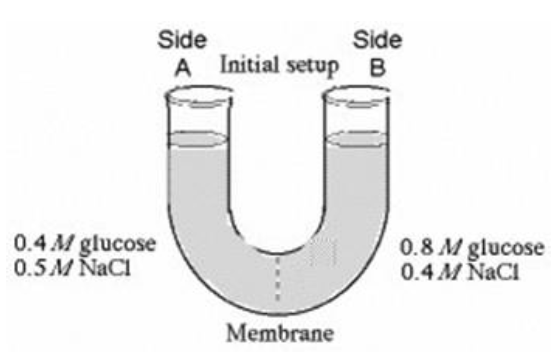
The solutions in the arms of a U-tube are separated at the bottom of the tube by a selectively permeable membrane. The membrane is permeable to sodium chloride but not to glucose. Side A is filled with a solution of 0.4 M glucose and 0.5 M sodium chloride (NaCl), and side B is filled with a solution containing 0.8 M glucose and 0.4 M sodium chloride. Initially, the volume in both arms is the same.

In the U-tube experiment illustrated above, which of the following statements correctly describes side B at equilibrium?

#Unit 2. Cellular Organization
  1. The concentration of NaCl and glucose will decrease, and the water level will increase.

  2. The concentration of NaCl will increase, the concentration of glucose will decrease, and the water level will increase.

  3. The concentration of NaCl will increase, the concentration of glucose will decrease, and the water level will decrease.

  4. The concentration of NaCl and glucose will increase, and the water level will decrease.

More Questions
TLS Online TPP Program

#Question id: 14708

#Unit 5. Developmental Biology

Difference between gastrulation in Xenopus and sea urchin;
I. In Xenopus, formation of blastopore: mesoderm and endoderm move inside by involution over blastopore lip.
II. In sea urchin, formation of blastopore: mesodermal cells migrate into the interior; endoderm moves inside by invagination of the epithelial sheet.

TLS Online TPP Program

#Question id: 14709

#Unit 5. Developmental Biology

Choose right statement about cleavage pattern and gastrulation movements;
1.At the end of cleavage the animal embryo is essentially a closed sheet of cells, which is often in the form of a sphere enclosing a fluid-filled interior. Gastrulation, strictly the formation of the gut, converts this sheet into a solid three-dimensional embryonic animal body. 
2.During cleavage, cells move into the interior of the embryo, and the regions of endoderm. and mesoderm. which were originally adjacent in the cell sheet, take up their appropriate positions in the embryo.
3. Gastrulation results from a well- defined spatio-temporal pattern of change in cell shape, cell movement, and change in cell adhesiveness, the main forces of which are generated by localized contractions.

TLS Online TPP Program

#Question id: 14710

#Unit 5. Developmental Biology

Splitting of one cellular sheet into two more or less parallel sheets. While on a cellular basis it resembles ingression, the result is the formation of a new (additional) epithelial sheet of cells, choose right gastrulation movement;

TLS Online TPP Program

#Question id: 14711

#Unit 5. Developmental Biology

Choose right explanations of gastrulation movements,  


TLS Online TPP Program

#Question id: 14712

#Unit 5. Developmental Biology

 Match the following cleavage pattern, with their egg type and cleavage type

CLEAVAGE PATTERNEGG TYPECLEAVAGE TYPE
1. HOLOBLASTIC CLEAVAGEa. IsolecithalI. Spiral cleavage
b. MesolecithalII. Displaced radial cleavage
2. MEROBLASTIC CLEAVAGEc. TelolecithalIII. Discoidal cleavage
d. CentrolecithalIV. Superficial cleavage

TLS Online TPP Program

#Question id: 14713

#Unit 5. Developmental Biology

Match their cleavage patterns with their belonging animals;

CLEAVAGE PATTERNANIMALS
1. HOLOBLASTIC BILATERAL CLEAVAGEP. Tunicates
2. MEROBLASTIC BILATERAL CLEAVAGEQ. Cephalopod molluscs
3. MEROBLASTIC DISCOIDAL CLEAVAGER. Amphibians
4. HOLOBLASTIC DISPLACED RADIAL CLEAVAGES. Reptiles